
 русский
 Español


Industry News
Waterproof Emergency Stop Pushbuttons: Demand Grows for Reliable Safety in Wet Areas
Date:Nov 27, 2026
Waterproof emergency stop pushbuttons are bought for safety circuits, and they are judged on the day someone actually presses one in a wet or dusty area. Buyers comparing models usually look at contact configuration, mounting size, and price, but the questions that matter are whether the seal still works after repeated pressing, whether the reset is deliberate enough to prevent accidental restart, and whether the button keeps water out after the panel has been washed down for a year.
The Contacts Open When the Button Is Pressed
The normally closed contact arrangement is fail-safe
An emergency stop pushbutton uses normally closed contacts. Press the button and the circuit breaks. If the wiring breaks or the contact fails, the circuit also breaks. The machine stops either way. That is the fail-safe principle. It is why emergency stops use normally closed contacts instead of normally open ones. A normally open contact would leave the machine running if the wire came loose.
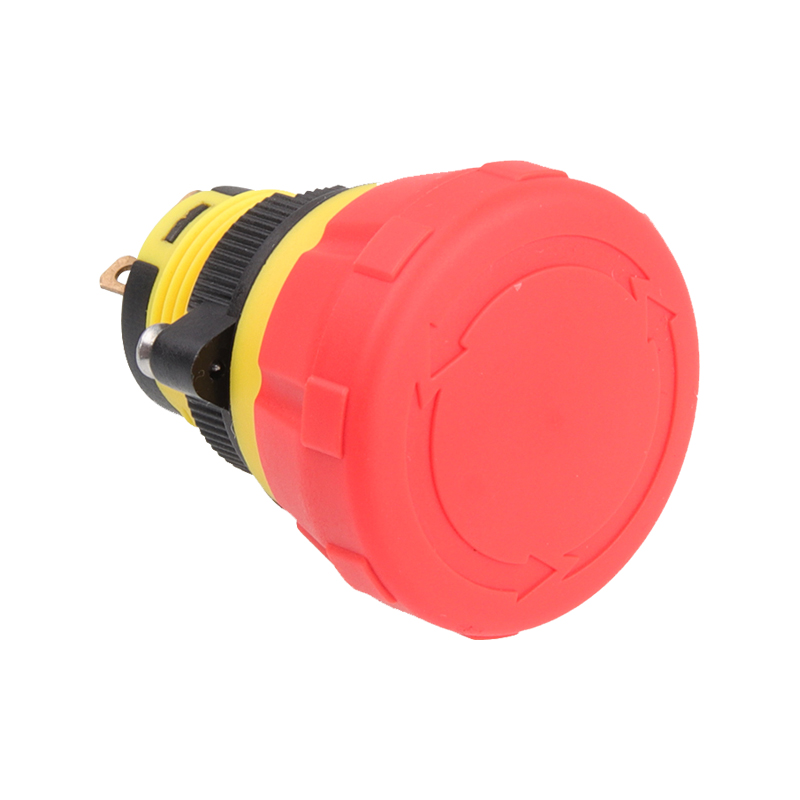
The button latches and releases with a twist or key
The button latches when pressed. It stays down until someone releases it. The machine cannot restart while the button is latched. Twist release is standard on most models. Key release is used where unauthorized restart is a concern. The key stays with the supervisor, and the machine cannot restart until the supervisor releases the button.
Sealing Keeps Water Out of the Contact Chamber
The actuator is sealed with a diaphragm or O-ring
Water enters a switch through the gap around the button. A rubber diaphragm or an O-ring seals that gap. The seal compresses when the button is pressed and returns when the button is released. The seal material matters. Nitrile works for water and oils. Silicone handles higher temperatures. EPDM resists cleaning chemicals. The wrong material swells or cracks within months.
The housing joints and cable entry are sealed
The housing is assembled from two or more parts. Gaskets or O-rings seal the joints. The cable enters through a gland with a rubber seal. The gland compresses around the cable. If the gland is loose or the cable diameter is wrong, water gets in. The cable entry is one of the most common failure points.
Common specs:
- Protection: IP65, IP67, IP68
- Housing: stainless steel or anodized aluminum
- Contact configuration: 1NC, 2NC, 1NO+1NC
- Contact rating: up to 10A
- Release: twist or key
- Mounting: panel mount, 22mm or 30mm cutout
- Button diameter: 40mm or 60mm
Food Processing and Marine Markets Drive Demand
Food plants need switches that survive washdown and hygiene inspection
Food plants wash equipment daily. The switch survives the washdown and the cleaning chemicals. It is used on conveyors, mixers, and packaging machines. The switch has to pass the plant's hygiene inspection, which means no crevices where bacteria can collect. A switch with a deep groove around the button is a hygiene risk even if it is waterproof.
Marine and outdoor equipment needs switches that resist salt and weather
Saltwater corrodes standard switches. Stainless steel and sealed actuators resist the salt. The switch operates on boats, docks, and offshore equipment. The marine version usually carries a higher IP rating because the exposure is constant. Aluminum that is not anodized will chalk and pit outdoors.
Buyers Focus on IP Rating, Contact Configuration, and Release Method
The IP rating must match the actual exposure
IP65 suits water jets. IP67 suits temporary immersion. IP68 suits continuous immersion. A switch rated IP65 will fail if it is hosed down daily. The buyer has to match the rating to the conditions, not the catalogue description.
The contact configuration and release method must match the safety circuit
The contact configuration must match the safety relay. 1NC, 2NC, or 1NO+1NC. The safety relay expects a specific configuration. The wrong configuration means the safety circuit does not work. The release method must match the safety policy. Twist release is standard. Key release prevents unauthorized restart.
Waterproof Emergency Stops Support Safety in Wet Areas
The button stops the machine immediately
The normally closed contacts open when the button is pressed. The machine stops. The operator does not have to hold the button down. The latch keeps the circuit open until someone releases it.
The switch stays sealed in washdown and rain
The diaphragm and housing seals keep water out. The switch operates in washdown and rain. The seal material is selected for the cleaning chemicals used in the plant.
The IP rating and housing material are selected for the exposure
Stainless steel suits saltwater. Anodized aluminum suits outdoor weather. The buyer matches the rating and material to the actual conditions, not the catalogue description.



Ready to experience the reliability and innovation of WANDU Electric switches?
© Zhejiang Wandu Electric Co., Ltd.
China Push-Button Switch
