What Is an Emergency Switch or Emergency Stop Button?
An Emergency Switch, commonly referred to as an Emergency Stop Button, is designed to bring a machine or process to a halt as quickly as possible when an abnormal or dangerous condition occurs. Its role is not to control normal operation but to interrupt power or control signals when safety is at risk.
From a technical standpoint, emergency stop buttons are typically wired using normally closed contacts. This means the circuit remains complete during normal operation and opens when the button is pressed or when a fault such as a broken wire occurs. This fail-safe logic ensures that loss of continuity results in a stop condition rather than continued operation.
Placement and accessibility are equally important. Emergency switches are positioned where operators can reach them quickly without hesitation. Color contrast, usually a red actuator on a contrasting background, helps ensure immediate recognition. Users should note that emergency stop devices are part of a broader safety system and must be integrated with appropriate control logic rather than treated as standalone components.
How Do Emergency Stop Pushbuttons Function in Systems?
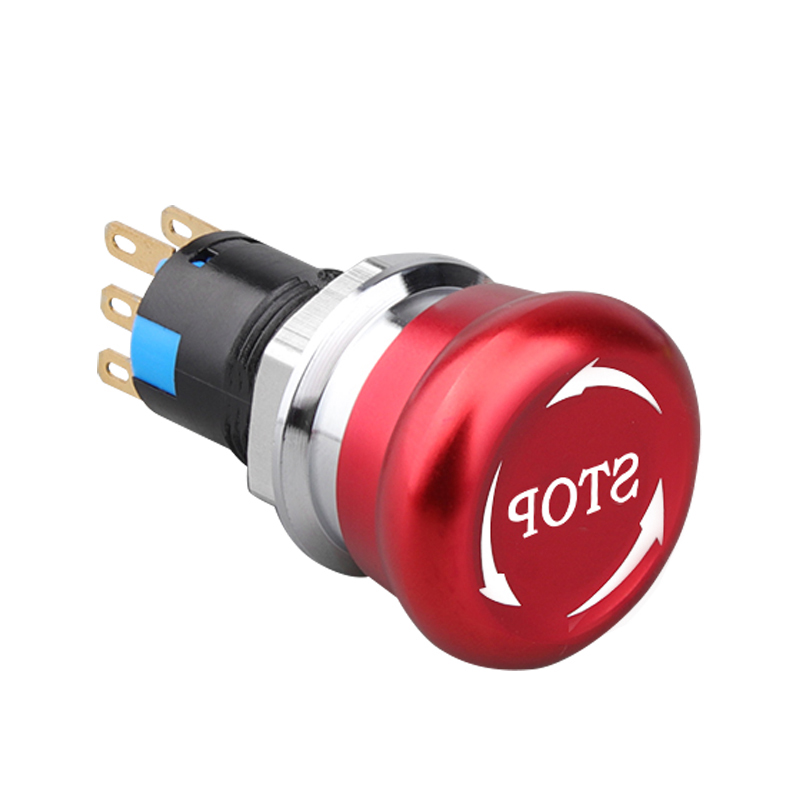
Emergency Stop Pushbuttons refer to the physical actuators used to trigger the emergency stop function. While the term overlaps with emergency stop buttons, it often emphasizes the mechanical interface between the operator and the safety circuit.
These pushbuttons are designed for decisive action. They usually feature a large mushroom-shaped head that can be activated with a hand, elbow, or even body weight if necessary. The actuation force and travel are engineered to reduce accidental triggering while still allowing fast response in emergencies.
From a practical perspective, emergency stop pushbuttons must maintain consistent performance over time. Mechanical wear, contamination, or improper mounting can reduce effectiveness. Regular inspection and testing are part of good safety practice, ensuring that the button actuates smoothly and that contacts respond as intended. Users should also ensure that pushbuttons comply with relevant safety standards applicable to their equipment and region.
Why Choose a Metal Emergency Stop Button?
A Metal Emergency Stop Button focuses on mechanical durability and environmental resistance. The metal housing provides protection against impact, vibration, and surface damage that can occur in industrial environments.
Metal construction is particularly useful in areas where equipment may be exposed to tools, moving parts, or frequent human contact. It also offers advantages in environments with temperature variation or exposure to oils and cleaning agents. However, metal housings require careful insulation design to prevent unintended electrical paths, as well as proper grounding where applicable.
For users, the decision to use a metal emergency stop button often depends on the surrounding conditions rather than the stopping function itself. While plastic-bodied devices may be sufficient for enclosed panels, metal versions are often selected for exposed mounting locations or heavy-duty machinery where physical robustness supports long-term usability.
What Makes a Latching Emergency Stop Button Important?
A Latching Emergency Stop Button remains in the activated position after being pressed. Unlike momentary switches, it requires a deliberate reset action—such as twisting or pulling—to return to its normal state. This behavior ensures that once an emergency stop is triggered, the system cannot restart automatically.
The latching mechanism supports safety by forcing operators to acknowledge the event and investigate the cause before resuming operation. In complex systems, this reduces the risk of restarting equipment while a hazard is still present. The reset action is intentionally distinct from normal operation controls, helping prevent confusion.
Users should consider reset method and location during design. Resetting should be possible only after the hazard has been addressed, and in some systems, additional interlocks or confirmations are required before power is restored.


 русский
 Español